

Whether you're a newly qualified diver monitoring your air consumption or an experienced technical diver planning more demanding dives, understanding your Surface Air Consumption (SAC) and Respiratory Minute Volume (RMV) is an essential part of dive planning.Use the calculator below to estimate your breathing rate based on your cylinder size, pressure, average depth and dive time.
Surface Air Consumption (SAC) is the amount of breathing gas you would consume per minute if you were breathing at the surface (1 ATA). Because breathing gas is compressed at depth, your actual gas usage underwater increases as ambient pressure increases. Calculating SAC allows divers to compare breathing rates between dives regardless of depth.
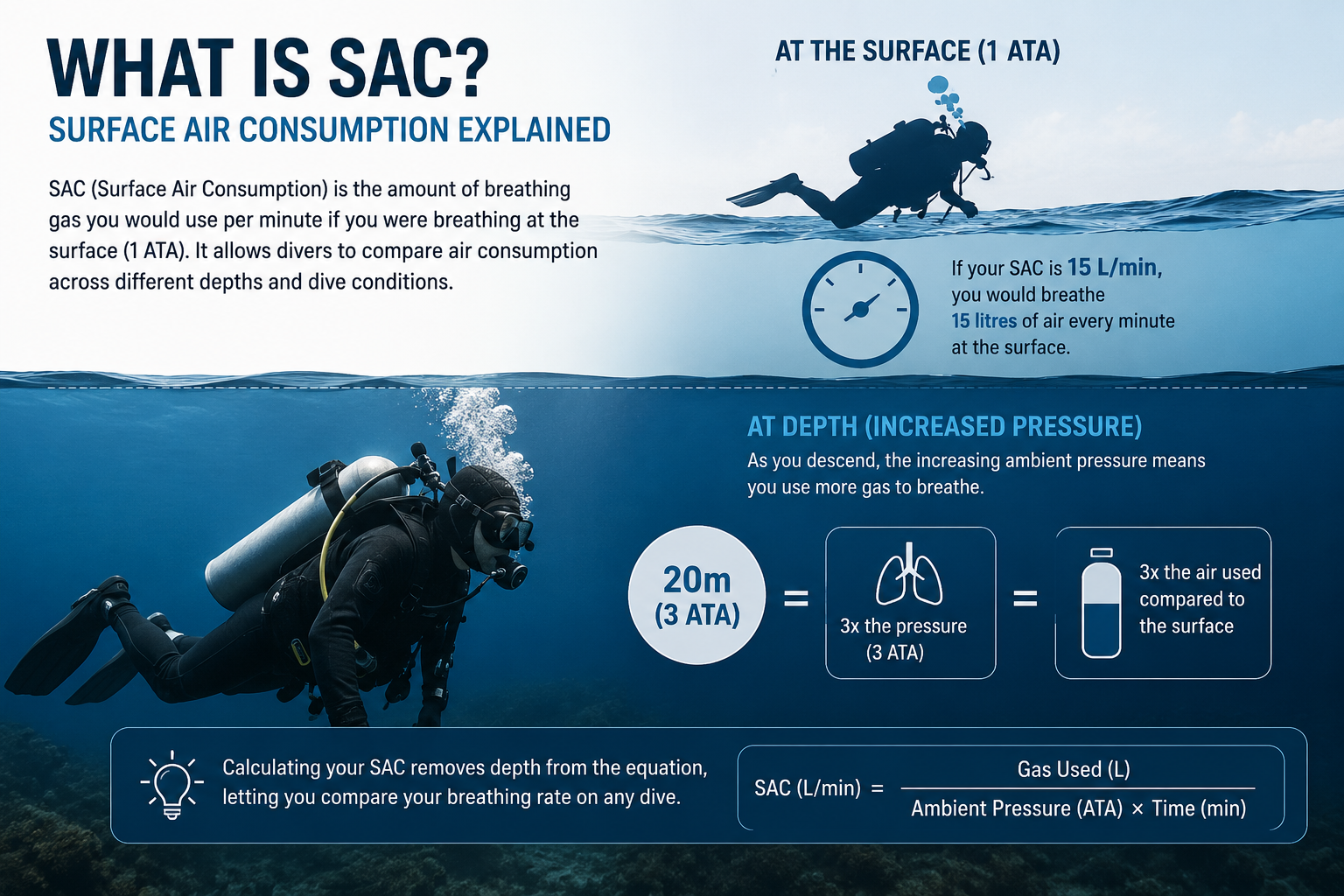
Respiratory Minute Volume (RMV) is closely related to SAC and represents the volume of gas you breathe each minute. Many instructors and technical divers prefer RMV because it can be applied directly to gas planning, reserve calculations and emergency scenarios.
The calculator follows these steps:
1. Calculates the pressure used during the dive.
2. Converts that pressure into the total volume of gas consumed.
3. Calculates the average ambient pressure based on depth.
4. Divides the gas consumed by dive time and ambient pressure.
The result is your estimated SAC or RMV expressed in litres per minute (or cubic feet per minute).
Knowing your SAC rate helps you:
- Plan dives more accurately
- Estimate gas requirements
- Improve gas management
- Compare breathing efficiency between dives
- Monitor improvements in buoyancy and trim
- Plan emergency gas reserves
- Calculate rock bottom gas
- Improve confidence before longer or deeper dives
For technical divers, an accurate SAC/RMV value is a key input for detailed gas planning.
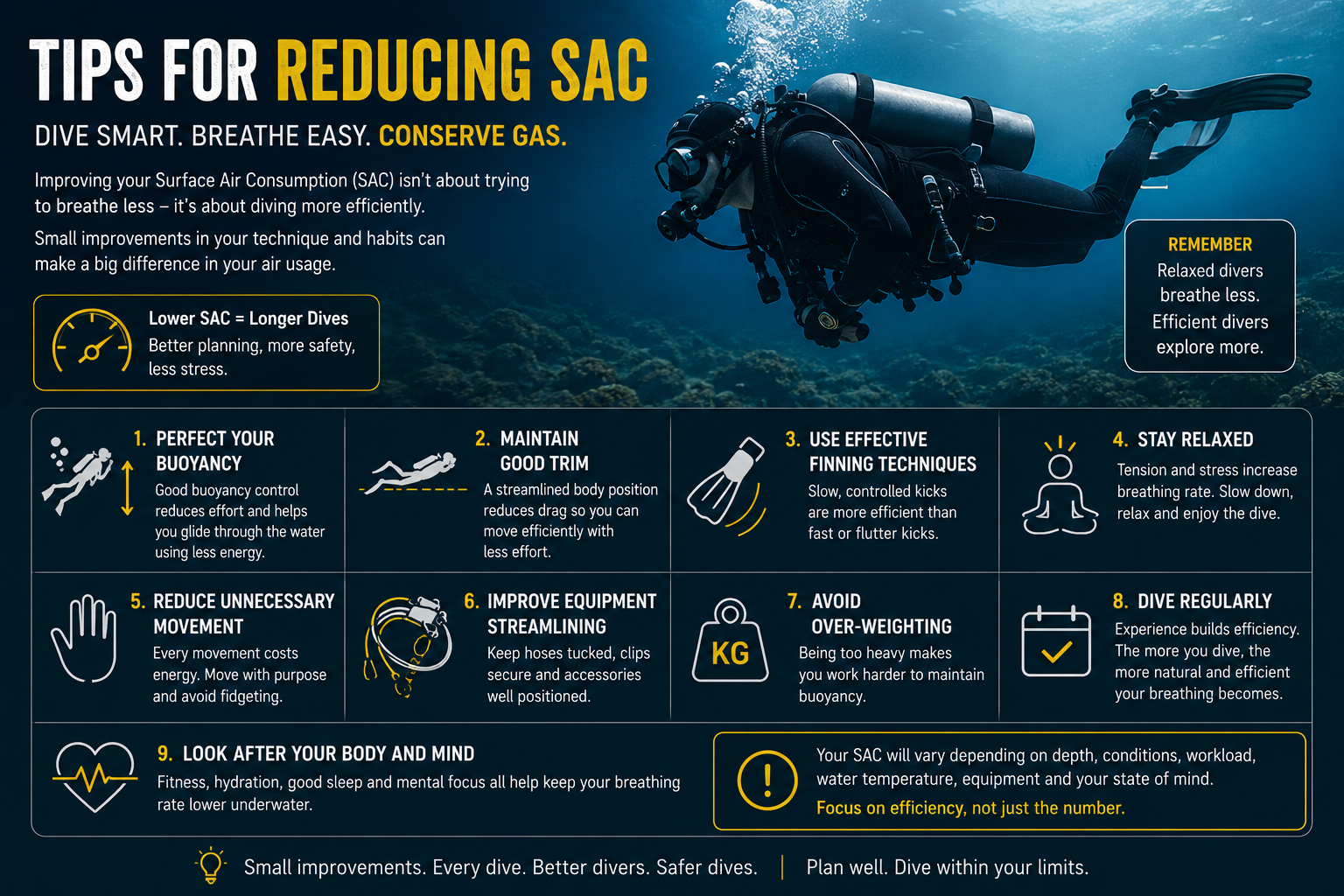
Improving SAC isn't about trying to breathe less—it's about diving more efficiently.
Consider:
- Perfecting your buoyancy control
- Maintaining good trim
- Using effective finning techniques
- Remaining relaxed throughout the dive
- Reducing unnecessary movement
- Reducing exessive adding/dumping of gas
- Improving equipment streamlining
- Avoiding over-weighting
- Practising regularly
Many divers naturally see their SAC improve as their experience increases.
Why is my SAC different on every dive?
Your breathing rate changes depending on depth, water temperature, current, workload, stress, fitness, exposure protection and the type of dive you're undertaking.
Can I use this calculator for technical diving?
Yes, but only as an aid to planning. Technical dives require comprehensive gas planning that takes into account team gas requirements, decompression obligations, contingencies and emergency reserves. This calculator should not replace formal planning procedures or appropriate training.
What's the difference between SAC and RMV?
SAC is often expressed as cylinder pressure per minute (or converted to litres per minute), while RMV refers to the actual volume of gas breathed each minute at the surface. In practice, many divers use the terms interchangeably, but RMV is generally the preferred metric for detailed gas planning because it directly represents gas volume.
Is a lower SAC always better?
No. Extremely low gas consumption isn't necessarily an indicator of a better diver. Safe diving, situational awareness and good decision-making are always more important than achieving a particular SAC value.
Contact us today and we will get you on the right track, with the right training & equpiment
