

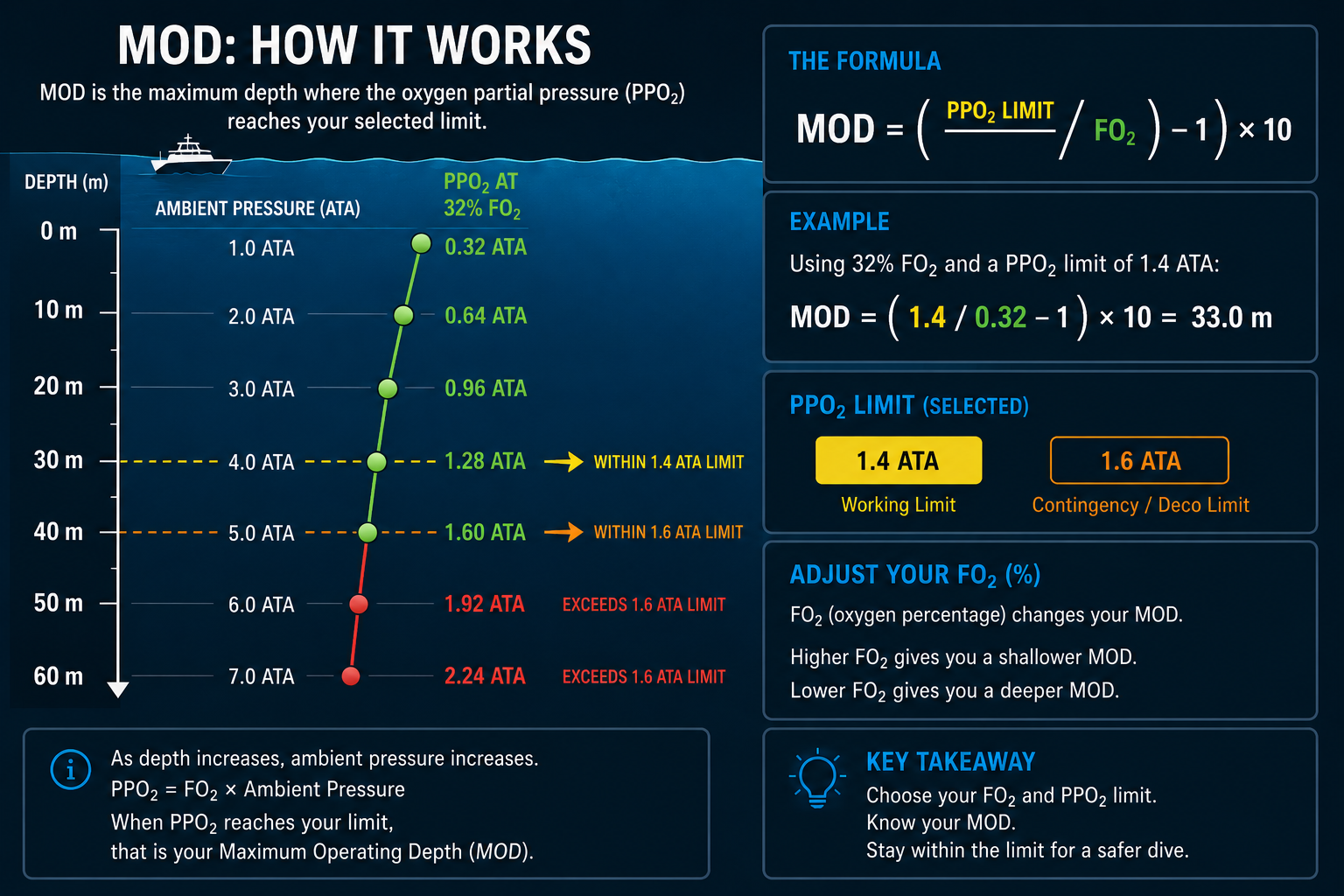
Use this Nitrox Planning Calculator to estimate your maximum operating depth, best Nitrox mix, gas density and rock bottom gas requirement for a planned dive.This tool is designed for divers who want a clearer understanding of how oxygen percentage, depth, PPO₂ limits, breathing rate and ascent profile affect dive planning.
Trimix diving allows technical divers to safely explore greater depths by replacing a portion of nitrogen with helium, reducing narcosis and improving breathing gas performance.This calculator combines several essential Trimix planning calculations into one easy-to-use tool. It can estimate an optimum Trimix for a planned depth, calculate Maximum Operating Depth (MOD), Equivalent Narcotic Depth (END), Equivalent Air Depth (EAD), Equivalent Air Density Depth (EADD), gas density and identify whether a gas is normoxic or hypoxic.The calculations are intended for educational use and as a planning reference. They are not a substitute for formal technical diving training or decompression planning software.
This calculator combines multiple Trimix calculations into a single planning tool. Depending on the information entered, it can:
• Calculate an optimum Trimix for a planned depth.
• Calculate the maximum operating depth for a known Trimix.
• Calculate Equivalent Narcotic Depth (END).
• Calculate Air Narcotic Depth (AND).
• Calculate Equivalent Air Depth (EAD).
• Calculate Equivalent Air Density Depth (EADD).
• Calculate breathing gas density at depth.
• Identify whether the selected gas is normoxic or hypoxic.
• Estimate the shallowest depth at which the selected gas can safely sustain life.
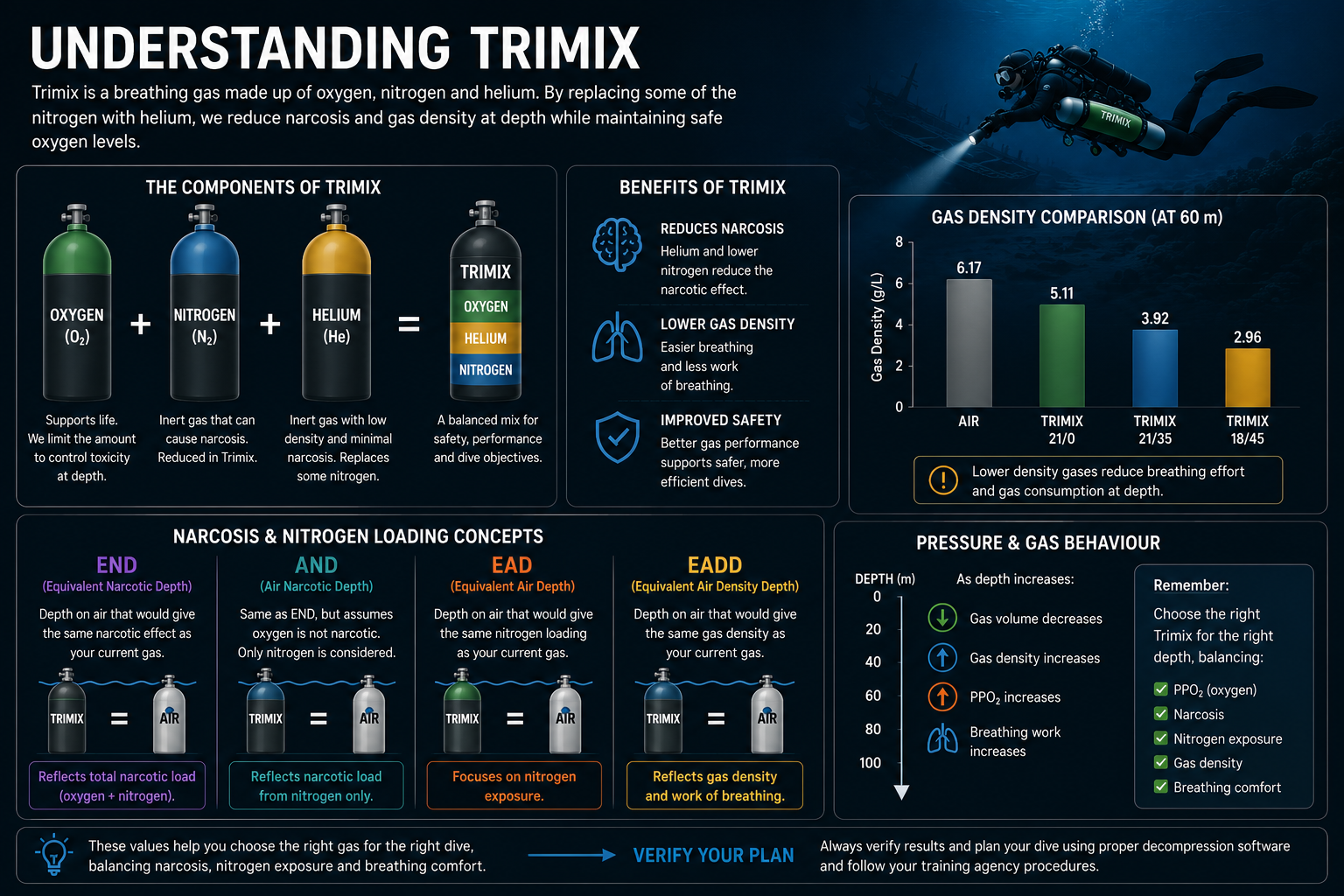
Trimix is a breathing gas consisting of oxygen, nitrogen and helium. By replacing some nitrogen with helium, Trimix reduces the narcotic effect of breathing gas at depth while also lowering gas density, making breathing easier during deep dives. Technical divers typically use Trimix whenever the combination of narcosis, oxygen exposure and gas density become limiting factors when diving on air or Nitrox.
One of the longest-running debates in technical diving is whether oxygen should be considered narcotic. Some training agencies assume oxygen contributes fully to narcosis, while others assume only nitrogen is narcotic. Rather than forcing one assumption it's possible Oxygen is partly narcotic and partly metabolised, thus this calculator allows both approaches. Switching the Oxygen Considered Narcotic option changes the virtual depth calculation from Equivalent Narcotic Depth (END) to Air Narcotic Depth (AND), allowing you to compare both planning philosophies.
Equivalent Narcotic Depth (END) is the depth on air at which a diver would experience approximately the same narcotic effect as the selected Trimix. Many technical divers aim for an END of around 30–35 metres, although acceptable values depend on personal preference, training, workload and the complexity of the dive.
Air Narcotic Depth (AND) uses the same principle as END but assumes oxygen is not narcotic. Some agencies teach AND rather than END. This calculator supports either approach using the Oxygen Considered Narcotic switch.

Equivalent Air Depth (EAD) compares the nitrogen loading of a Trimix or Nitrox dive with an equivalent dive on air. Although originally developed for Nitrox planning, EAD remains useful for comparing nitrogen exposure between different breathing gases.
Equivalent Air Density Depth (EADD) compares the density of a breathing gas with the density of air. As gas becomes denser it becomes more difficult to breathe, increasing work of breathing and potentially increasing carbon dioxide retention. Modern technical diving places increasing emphasis on gas density rather than narcosis alone when selecting breathing gases.
Gas density increases in direct proportion to ambient pressure. Even when oxygen exposure and narcosis remain acceptable, dense breathing gas increases respiratory effort and can contribute to elevated carbon dioxide levels. Many technical divers aim to keep breathing gas below approximately 5.2 g/L where practical, although different organisations may recommend different planning limits depending on the type of dive.
Normoxic Trimix contains sufficient oxygen to be breathed safely from the surface. Hypoxic Trimix contains less oxygen and cannot safely sustain life at the surface. These gases must only be breathed once sufficient depth has been reached to produce an adequate oxygen partial pressure. The calculator identifies the gas type and estimates the shallowest depth at which the gas can safely sustain life using a minimum PPO₂ of approximately 0.16 ATA.
What is the best END for Trimix?
Many technical divers aim for an END between 30 and 35 metres, although the most appropriate value depends on training, personal tolerance, workload and the objectives of the dive.
Should Oxygen be considered Narcotic?
There is no universal agreement. Some agencies treat oxygen as fully narcotic, while others assume only nitrogen contributes to narcosis. This calculator supports either planning approach. A suggested approach would be to assume that some part of Oxygen is Narcotic, while other parts are being Metabolised, where that ratio sits is unclear.
Does Nitrox affect rock bottom gas?
Not directly. Rock bottom gas is based on gas volume, breathing rate, depth, ascent time and team size. Nitrox affects oxygen exposure and gas density, but emergency reserve planning is still based on the amount of breathing gas required.
What is the difference between END and EAD?
END estimates the narcotic effect of a breathing gas, while EAD estimates the nitrogen exposure compared with breathing air. They describe different aspects of the dive and should not be used interchangeably.
Why is gas density importan?
Gas density directly affects work of breathing. Dense gas requires greater breathing effort and may contribute to carbon dioxide retention, particularly during deep or physically demanding dives.
FINAL DISCLAIMER
This calculator is provided for educational purposes only. It should never be used as the sole basis for planning or conducting a dive. Always analyse your breathing gases, verify calculations independently, use recognised decompression planning software, and follow the standards of your training agency and dive team procedures.
Contact us today and we will get you on the right track, with the right training & equpiment
